BSTIND ZDR6 direct operated pressure reducing valve is a high-precision hydraulic pressure control component designed for stable secondary circuit pressure regulation. It is fully interchangeable with Rexroth ZDR6 series and engineered for industrial hydraulic systems requiring consistent pressure stability under variable flow and load conditions.
We are BSTIND hydraulic valves manufacturing company, specializing in industrial hydraulic control components. We provide high-performance replacement solutions for Rexroth ZDR6, delivering equivalent hydraulic performance, installation compatibility, and stable long-term operation in industrial applications.
Bstind Hydraulic Valve Manufacturing Solution
BSTIND focuses on manufacturing hydraulic valves that can directly replace standard industrial components such as Rexroth ZDR6, while maintaining consistent performance and installation compatibility. Bstind ZDR6 series is designed to match the same NG6 (CETOP 3) interface and pressure control behavior, allowing integration into existing systems without modification. Bstind support replacement for commonly used OEM models, including R900483788 and R900401216, ensuring reliable interchangeability in practical applications.
What is a ZDR6 Pressure Reducing Valve?
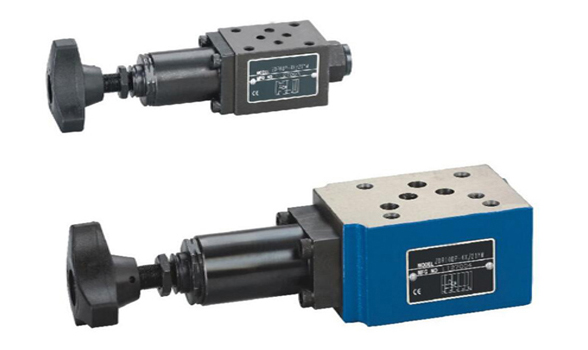
A ZDR6 pressure reducing valve is a direct-operated hydraulic pressure control valve (NG6 / CETOP 3) used to reduce and maintain a constant, preset outlet pressure in a specific branch of a hydraulic system, regardless of fluctuations in the main line pressure.
It is commonly used when different parts of a hydraulic circuit require different working pressures. The valve ensures that only the required reduced pressure is delivered downstream, protecting components and maintaining stable operation.
Typical OEM reference examples include R900483788 and R900401216, which correspond to ZDR6-type pressure reducing valve configurations used in industrial hydraulic systems.
ZDR6 Valve Working Principle
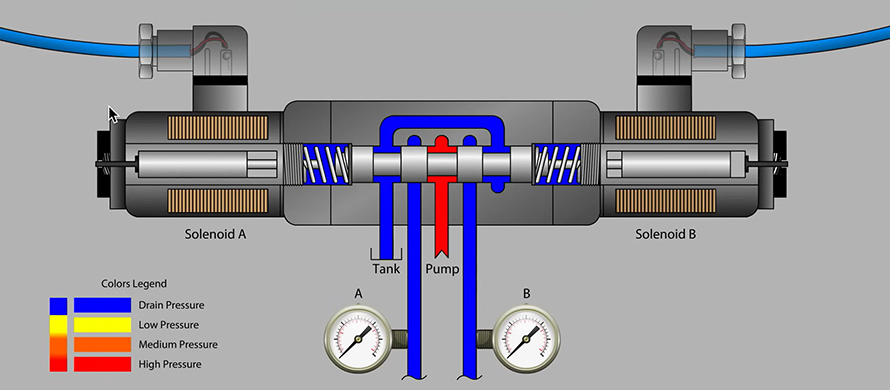
The ZDR6 pressure reducing valve works by using a direct mechanical force balance between a preset spring force and the downstream (outlet) pressure. The spring defines the target pressure level, while the outlet pressure acts on the opposite side of the control spool. When the outlet pressure rises above the preset value, the spool shifts to restrict flow and reduce pressure. When the pressure drops below the setting, the spool reopens to restore flow and maintain the required level. This continuous adjustment allows stable pressure control without any external pilot signal.Key behavior characteristics include:
ZDR6 Application Context
Bstind ZDR6 valve is designed for secondary pressure control in hydraulic circuits where multiple pressure zones must operate independently. In practical applications, this includes:
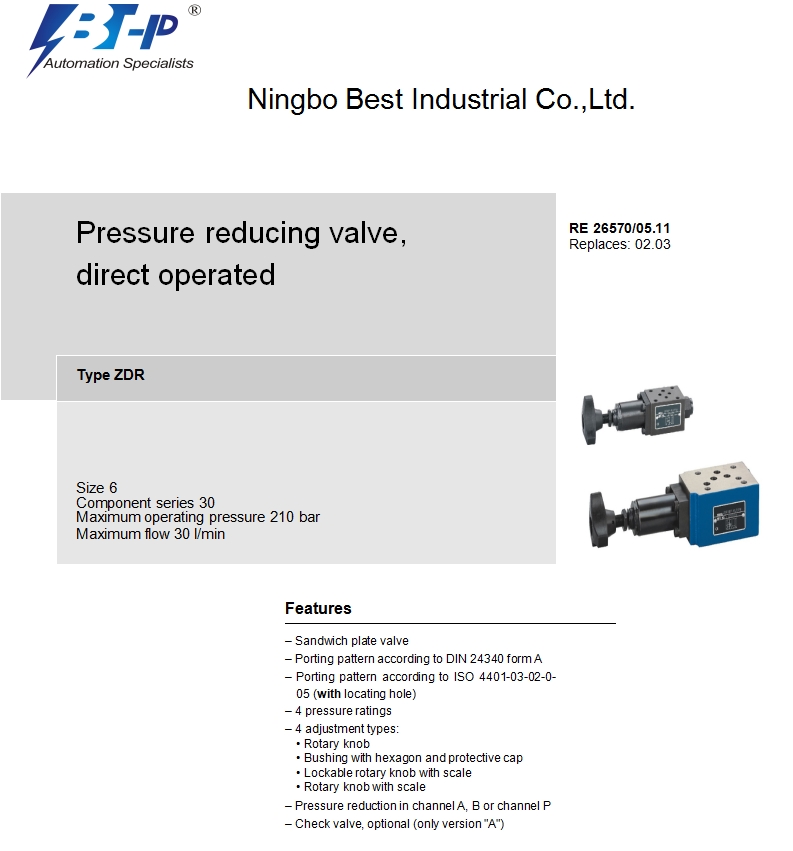
ZDR6 Direct Operated Pressure Reducing Valve
Port pattern is according to DIN24340 form A and ISO 4401-03-02-0-05 standards
With 4 pressure ratings:2.5Mpa,7.5MPa,15MPa,21Mpa
And 3 optional pressure adjustment types:
Rotary knob
Bushing with hexagon and protective cap
Lockable rotary knob
Max.Flow:30L/min
Max.pressure:21Mpa
How to Select ZDR6 Pressure Reducing Valve
ZDR6 Pressure Technical Documentation
Selecting a BSTIND ZDR6 pressure reducing valve is mainly about ensuring that the valve can provide stable downstream pressure control while fitting directly into the existing hydraulic system. In most cases, correct selection depends on matching the valve’s size, pressure setting, and functional configuration with the actual working conditions.
Ordering Code Diagram
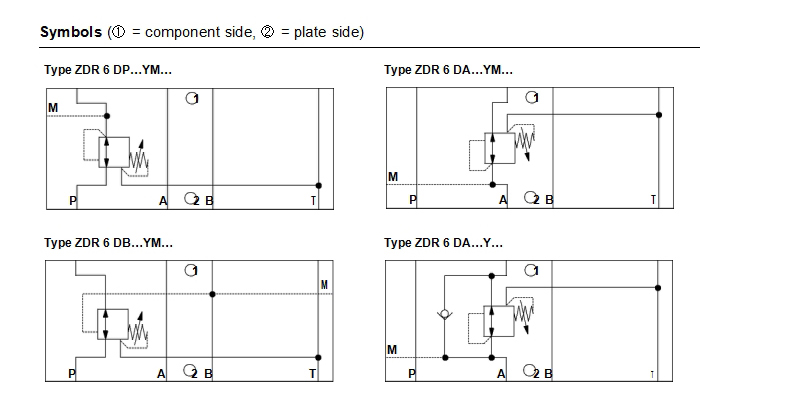
Symbols Diagram
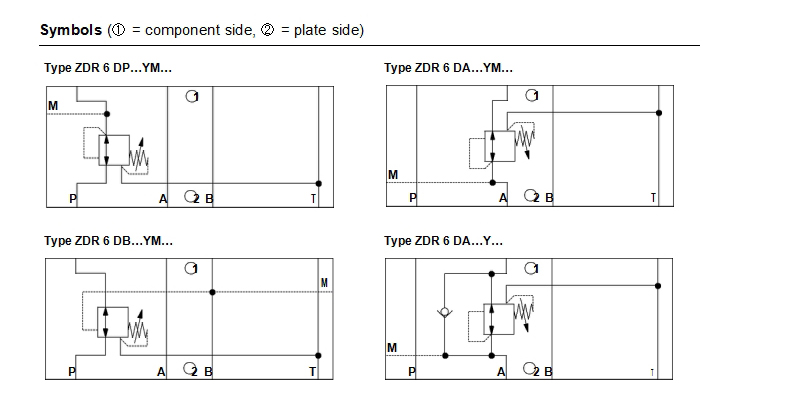
Technical Data Diagram
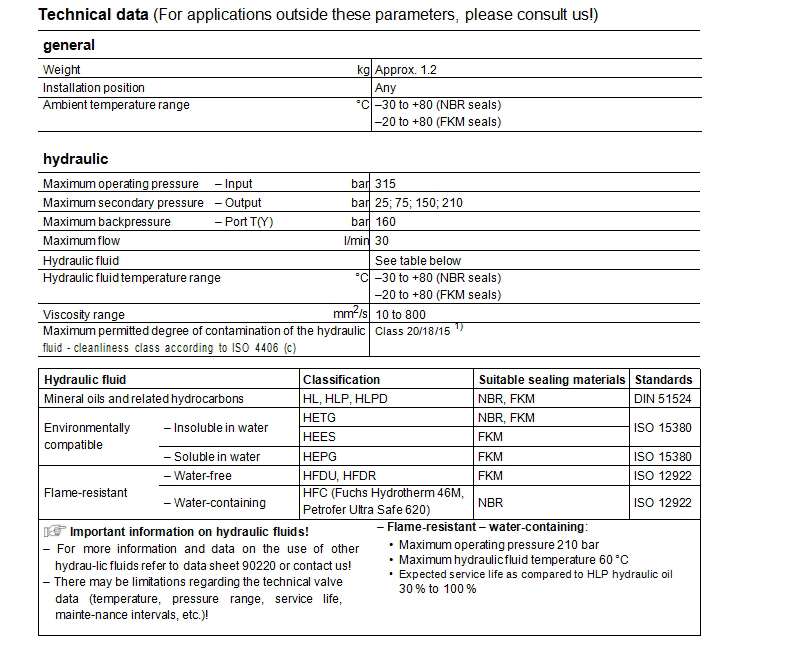
Characteristic Curves Diagram
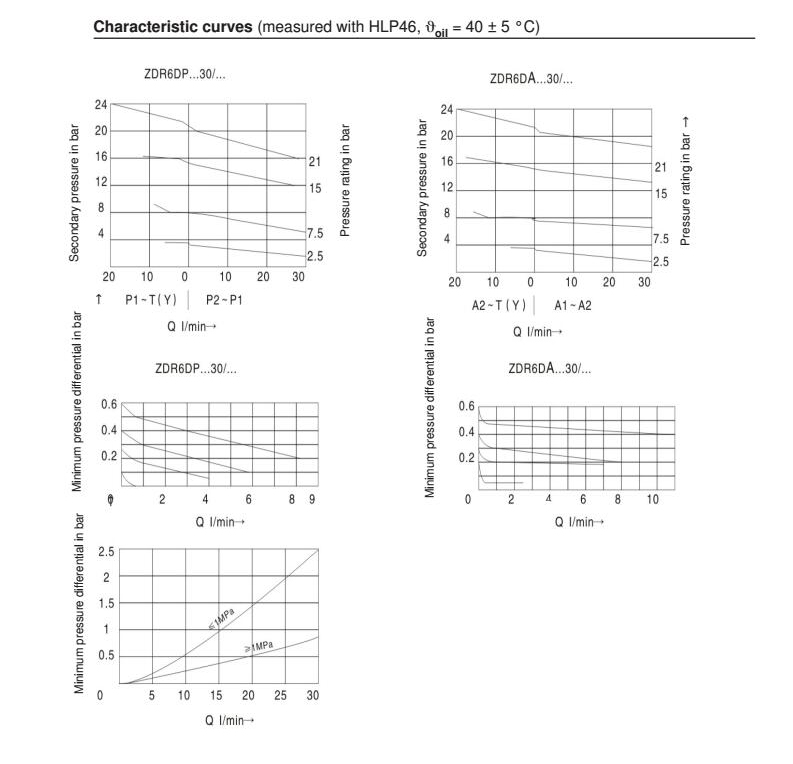
Unit Dimensions Diagram
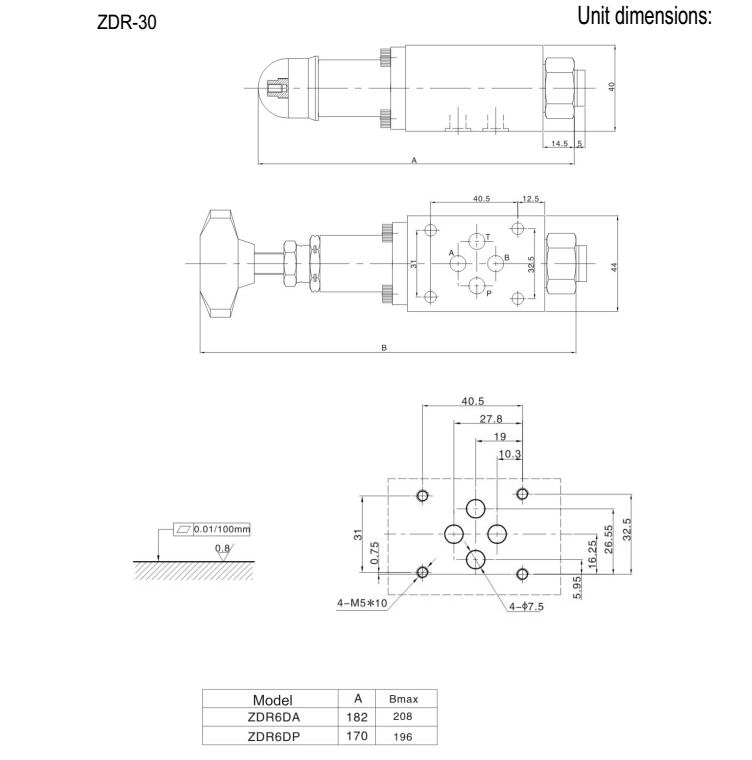
ZDR6 Pressure Reducing Valve Applications
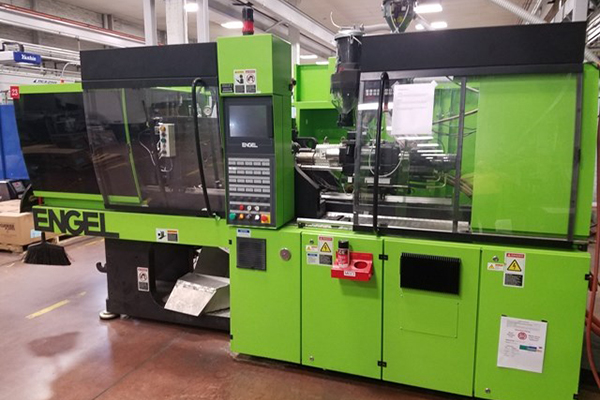
Injection Molding Machines
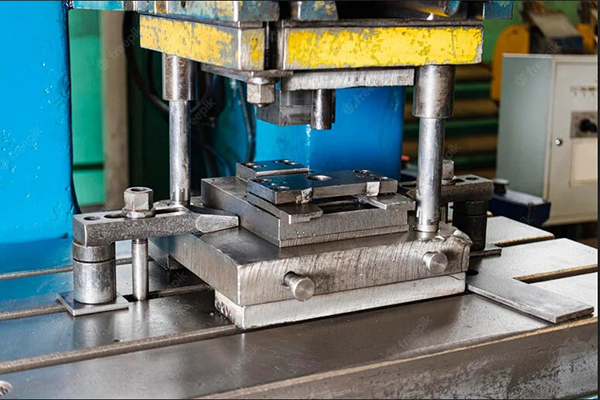
Hydraulic Press Equipments
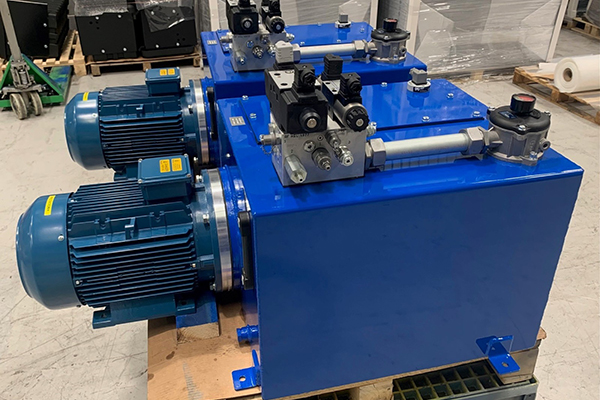
Industrial Power Units
Bstind Engineering Value
BSTIND focuses on manufacturing hydraulic valves that ensure functional equivalence, dimensional consistency, and reliable performance in industrial applications. The engineering approach is based on matching standard valve platforms, allowing seamless integration into existing hydraulic systems. Rather than redesigning the system, BSTIND valves are developed to fit directly into established interfaces and maintain the same operating behavior, reducing replacement risk and engineering complexity. Key values include:

 Contact our engineering team for technical support and quotation.